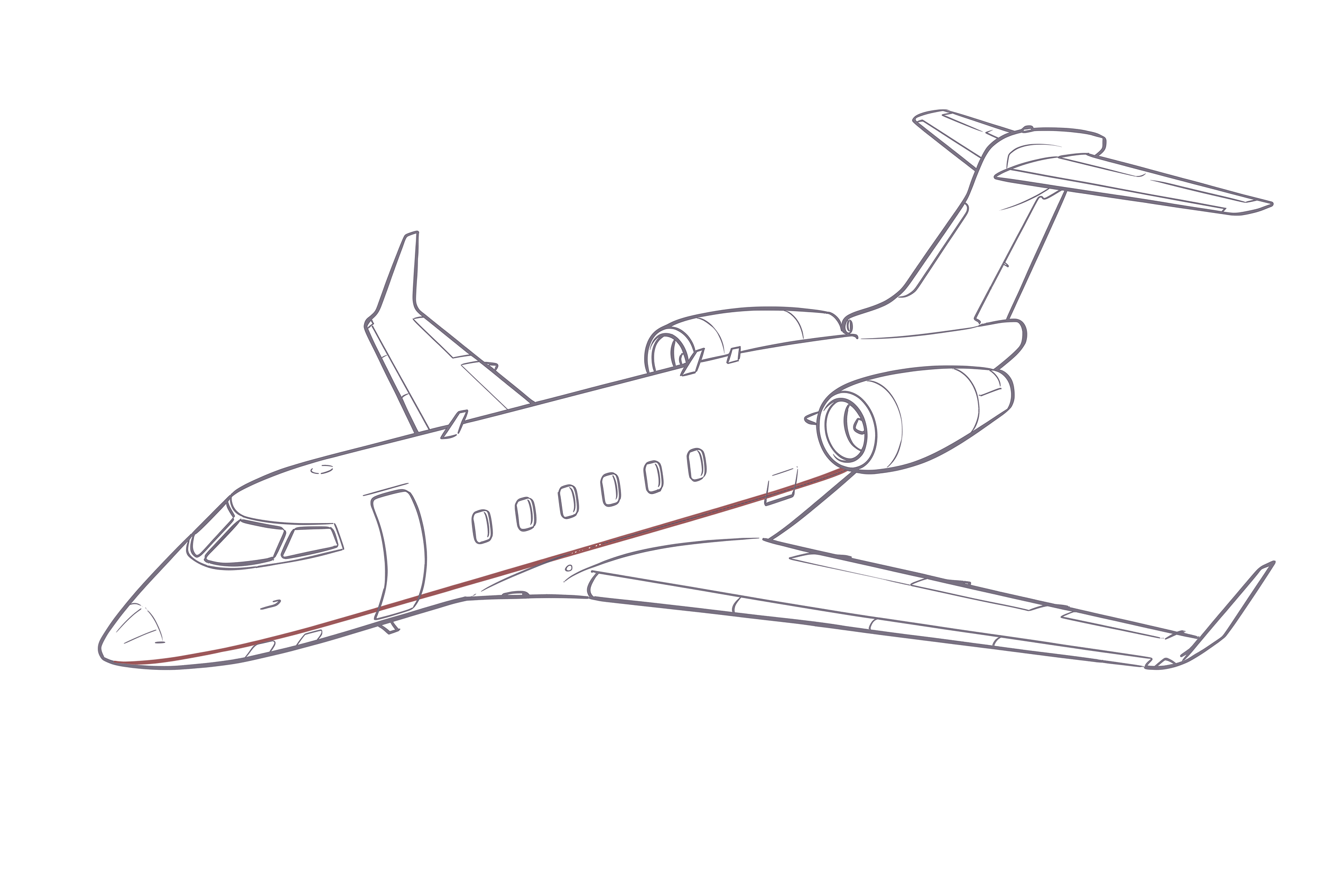
Bombardier Challenger 350
Super Mid-Size Jet
- Range
- 3,269nm
- Seats
- 9
The Bombardier Challenger 300 is a super-midsize jet valued for its flat-floor cabin, transcontinental range and balanced runway performance.
The Bombardier Challenger 300's maximum range is 3,340 nautical miles — 700 nm less than the Embraer Praetor 600, the longest-legged Super Mid-Size Jet in our set.
Reach
Teterboro · TEB — click a point, or focus the map and use arrow keys
Departure point: New York, Teterboro · TEB.
Great-circle reach at maximum published range — a still-air planning figure. Winds, payload, and reserves reduce real-world reach.
| Maximum range | 3,340 nm |
|---|---|
| Max operating speed | 320 KIAS |
| Service ceiling | 45,000 ft |
| FAA landing distance | 2,290 ft |
| Typical passengers | 8 |
|---|---|
| Typical crew | 2 |
| Cabin length | 283 in |
| Cabin width | 86 in |
| Cabin height | 73 in |
| Cabin volume | 930 cu ft |
| Baggage volume | 106 cu ft |
| Max takeoff weight | 38,850 lbs |
|---|---|
| Thrust per engine | 7,000 lbf |
| Engines | 2 |
| Engine model | Honeywell Aerospace HTF7000 |
| Exterior length | 68.6 ft |
| Wingspan | 63.8 ft |
Ask our team about current supply, pricing, and timing for this model.
Aircraft decision brief
Model overview
The Challenger 300 was a clean-sheet Bombardier design positioned between midsize aircraft and larger-cabin Challengers. Its stand-up, flat-floor cabin, eight-passenger layout and externally accessible baggage compartment make it practical for coast-to-coast business missions.
Honeywell HTF7000-series engines and a conventional systems architecture helped establish the platform that later evolved into the Challenger 350. Production of the 300 designation concluded in 2014 as the upgraded model entered service.
Mission fit
Decision lens
Planning lens
Confirm HTF7000 engine-program status, APU coverage and the position of major airframe inspections. Early and high-utilization aircraft require close review of cycles, corrosion prevention, landing gear and service-bulletin compliance.
Cabin-management systems, connectivity and avionics upgrade status vary considerably. Reconcile the aircraft empty weight and equipment list with the planned passenger, baggage and runway mission.
Category context
The Challenger 300 generally costs less to acquire than a Challenger 350 while retaining the same basic cabin concept. The 350 adds later avionics, winglets, cabin refinements and performance improvements, so buyers should compare upgrade exposure with the price premium.
From model research to market search
Specifications are only the starting point. Current supply, configuration, maintenance status, price, and timing determine which aircraft fit an acquisition or sale strategy.
Related