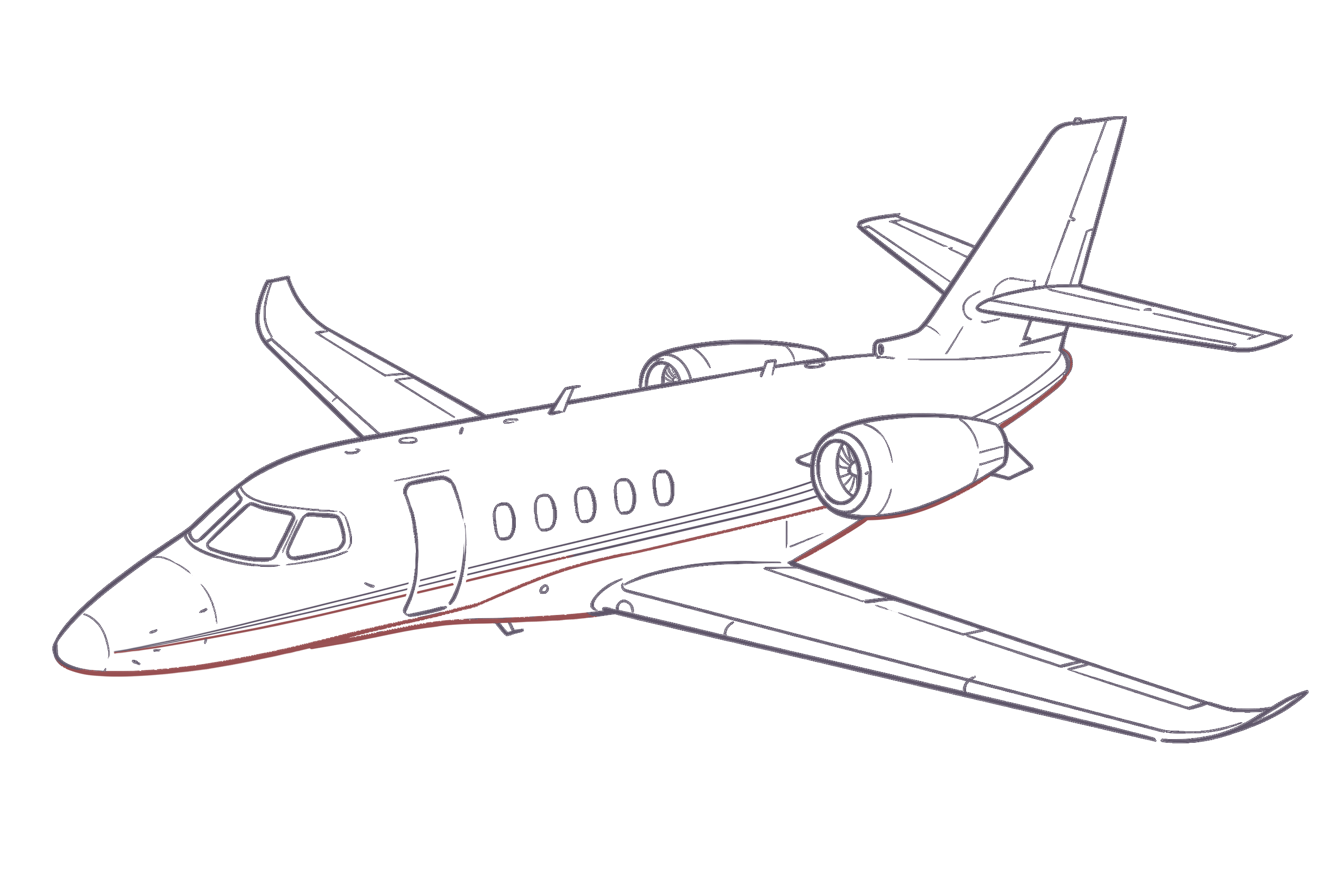
Citation III
Mid-Size Jet
- Range
- 2,470nm
- Seats
- 8
Learjet 55 is a mid-size jet designed around speed, climb performance, and a compact ramp footprint, with a typical 8-passenger configuration and a published maximum range of 2,296 nautical miles.
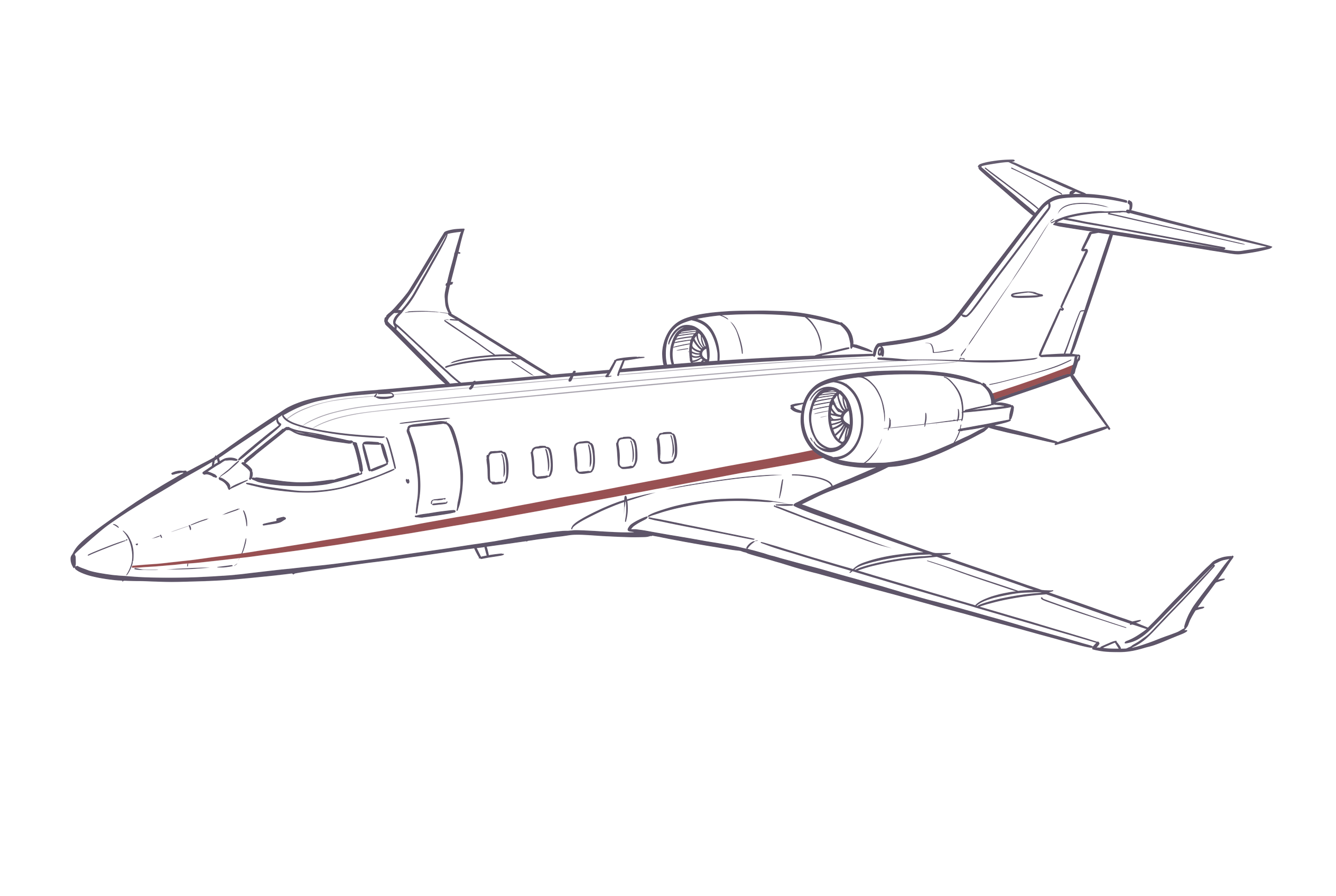
The Learjet 55's maximum range is 2,296 nautical miles — 1,116 nm less than the Embraer Praetor 500, the longest-legged Mid-Size Jet in our set.
Reach
Teterboro · TEB — click a point, or focus the map and use arrow keys
Departure point: New York, Teterboro · TEB.
Great-circle reach at maximum published range — a still-air planning figure. Winds, payload, and reserves reduce real-world reach.
| Maximum range | 2,296 nm |
|---|---|
| Max operating speed | 350 KIAS |
| Service ceiling | 51,000 ft |
| FAA landing distance | 3,300 ft |
| Typical passengers | 8 |
|---|---|
| Typical crew | 2 |
| Cabin length | 163 in |
| Cabin width | 69 in |
| Cabin height | 67 in |
| Cabin volume | 461 cu ft |
| Baggage volume | 58 cu ft |
| Max takeoff weight | 19,500 lbs |
|---|---|
| Thrust per engine | 3,700 lbf |
| Engines | 2 |
| Engine model | Honeywell TFE731-3A-2B |
| Exterior length | 55.1 ft |
| Wingspan | 43.8 ft |
Ask our team about current supply, pricing, and timing for this model.
Aircraft decision brief
Model overview
Learjet 55 sits within the Learjet family as a Mid-Size Jet. Its published specifications pair a 2-engine configuration with a 51,000-foot service ceiling and mission capability suited to regional and domestic business travel.
The cabin is approximately 67 inches high and 69 inches wide, with 461 cubic feet of cabin volume and 58 cubic feet of baggage capacity. Published field length is 3,300 feet. Actual runway and range performance varies with payload, weather, elevation, temperature, reserves, and aircraft configuration.
Mission fit
Decision lens
Planning lens
Prospective owners should test the Learjet 55's payload, range, runway, baggage, and cabin profile against their recurring missions. Published maximum figures are planning references; real-world capability depends on loading, reserves, weather, airport conditions, and the individual aircraft's configuration.
For a pre-owned example, diligence should address engine and auxiliary-power-unit status, program coverage, logbook continuity, calendar- and cycle-driven inspections, landing gear, pressurization, corrosion, avionics supportability, cabin systems, prior repairs, and parts availability. Upcoming maintenance and modernization can outweigh a low acquisition price.
Category context
Within the Learjet family, the closest published mission-profile comparisons are Learjet 55B and Learjet 55C. The Learjet 55 lists 2,296 nautical miles of maximum range and 461 cubic feet of cabin volume, versus 2,250 nautical miles and 473 cubic feet for the Learjet 55B, and 2,222 nautical miles and 473 cubic feet for the Learjet 55C. Buyers should also compare payload, runway performance, maintenance status, configuration, and total ownership budget.
From model research to market search
Specifications are only the starting point. Current supply, configuration, maintenance status, price, and timing determine which aircraft fit an acquisition or sale strategy.
Related