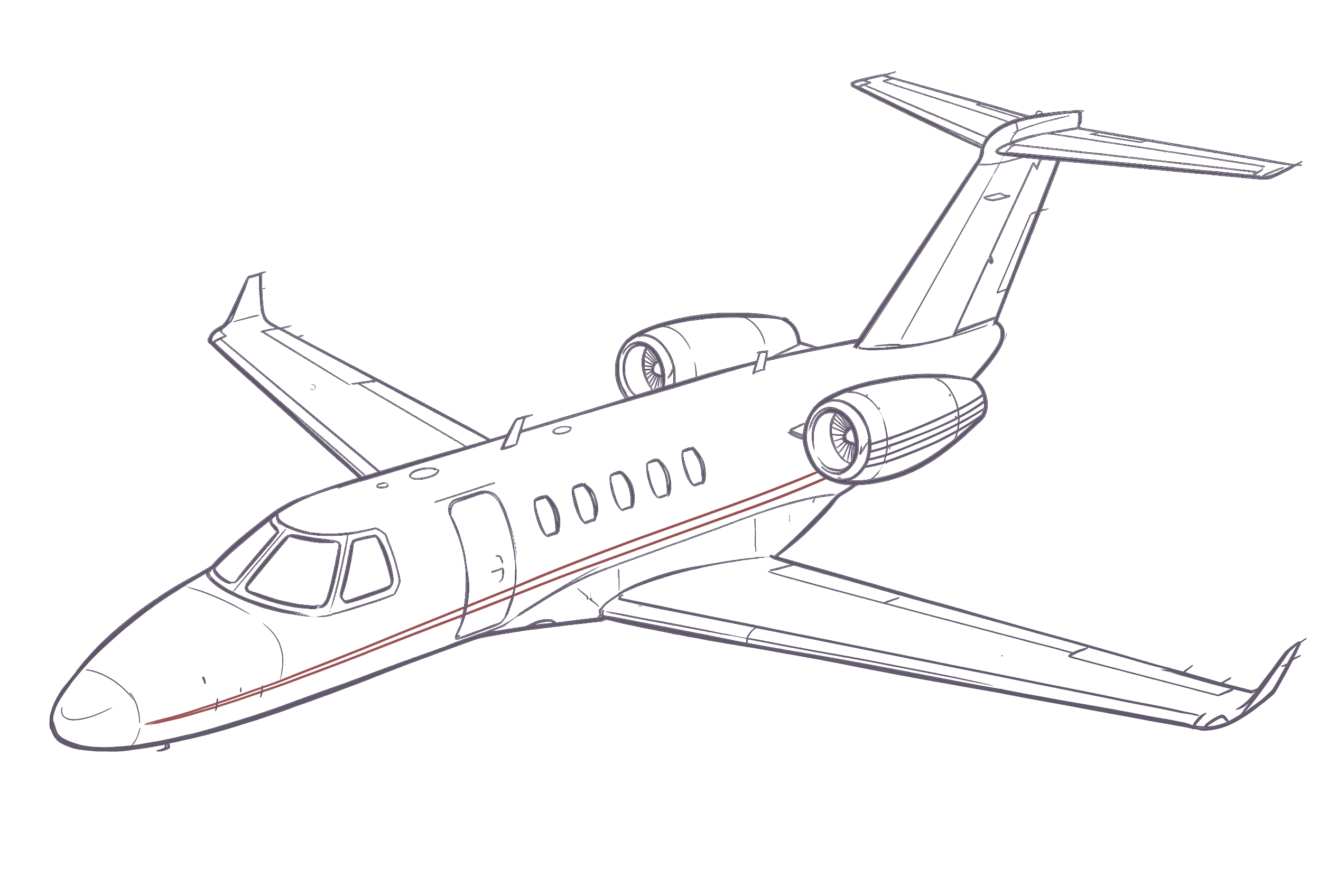
Citation CJ3
Light Jet
- Range
- 1,875nm
- Seats
- 6
The Citation Bravo is a light jet valued for straightforward operation, efficient short- and medium-range travel, and access to smaller airports, with a comfortable cabin for typical four- to seven-passenger missions.
The Citation Bravo's maximum range is 1,740 nautical miles — 968 nm less than the Learjet 36A, the longest-legged Light Jet in our set.
Reach
Teterboro · TEB — click a point, or focus the map and use arrow keys
Departure point: New York, Teterboro · TEB.
Great-circle reach at maximum published range — a still-air planning figure. Winds, payload, and reserves reduce real-world reach.
| Maximum range | 1,740 nm |
|---|---|
| Max operating speed | 275 KIAS |
| Service ceiling | 45,000 ft |
| FAA landing distance | 2,517 ft |
| Typical passengers | 7 |
|---|---|
| Typical crew | 2 |
| Cabin length | 188 in |
| Cabin width | 56 in |
| Cabin height | 55 in |
| Cabin volume | 292 cu ft |
| Baggage volume | 74 cu ft |
| Max takeoff weight | 14,800 lbs |
|---|---|
| Thrust per engine | 2,887 lbf |
| Engines | 2 |
| Engine model | Pratt & Whitney Canada PW530A |
| Exterior length | 47.2 ft |
| Wingspan | 52 ft |
Ask our team about current supply, pricing, and timing for this model.
Aircraft decision brief
Model overview
Produced through 2006, the Bravo combined the familiar Citation II cabin with more efficient Pratt & Whitney Canada engines, trailing-link landing gear, and updated avionics. It remains attractive to owner-operators and small flight departments seeking predictable utility without moving into a larger jet category.
Its strengths are runway flexibility, relatively modest operating requirements, and a practical balance of cabin size and range. As with most light jets, real-world range and baggage planning depend on passenger load, weather, reserves, and runway conditions.
Mission fit
Decision lens
Planning lens
Buyers should evaluate engine program status, hot-section and overhaul timing, avionics capability, pressurization and environmental systems, windshield condition, and logbook continuity. A lower-priced aircraft with deferred engine or avionics needs can quickly lose its apparent advantage.
The Bravo has a broad support base, but individual aircraft may range from largely original to extensively modernized. Mission analysis should confirm payload and range needs, especially for hot-weather, high-elevation, or baggage-heavy trips.
Category context
Compared with the Citation Encore, the Bravo generally offers a lower acquisition cost and simpler mission profile, while the Encore provides more performance and range. The CJ2 is faster and uses a more modern straight-wing Citation design, but its cabin and ownership tradeoffs differ.
From model research to market search
Specifications are only the starting point. Current supply, configuration, maintenance status, price, and timing determine which aircraft fit an acquisition or sale strategy.
Related